

Ailinos
The piece is finished. It will be titled: Bells. Ailinos for baritone, bass, children’s voices, percussion, piano, and strings.
Ailinos means, roughly, lament. It seems to me that lament is one of the central figures of today’s culture. Despite all appearances. I do not mean only so-called high culture (in which it is sometimes difficult to discern any relatable figures at all); I mean living culture in the broadest sense, in its various manifestations, including the most popular and commercially conditioned ones. Just beneath its lining, there is lament. A plaintive cry. That is how I see it, and how I hear it.
Crying does not necessarily have to be mournful in character. It does not have to express hopelessness. It can be a piercing, raw, purifying expression of sorrow, astonishment, longing, and acceptance of the state of things all at once.
Following the Greek thread, and with the Author’s permission, I incorporated two quotations into the text: the so-called Song of Seikilos (the oldest surviving fragment of musical notation, with an intriguing text over which there is still debate as to whether it should be interpreted as a funerary epitaph or as an affirmative declaration of the joy of life), and a fragment of a lullaby from Theocritus’ Idyll 24 (in which the infant Heracles reveals his strength for the first time by killing the two snakes sent by Hera to devour him).
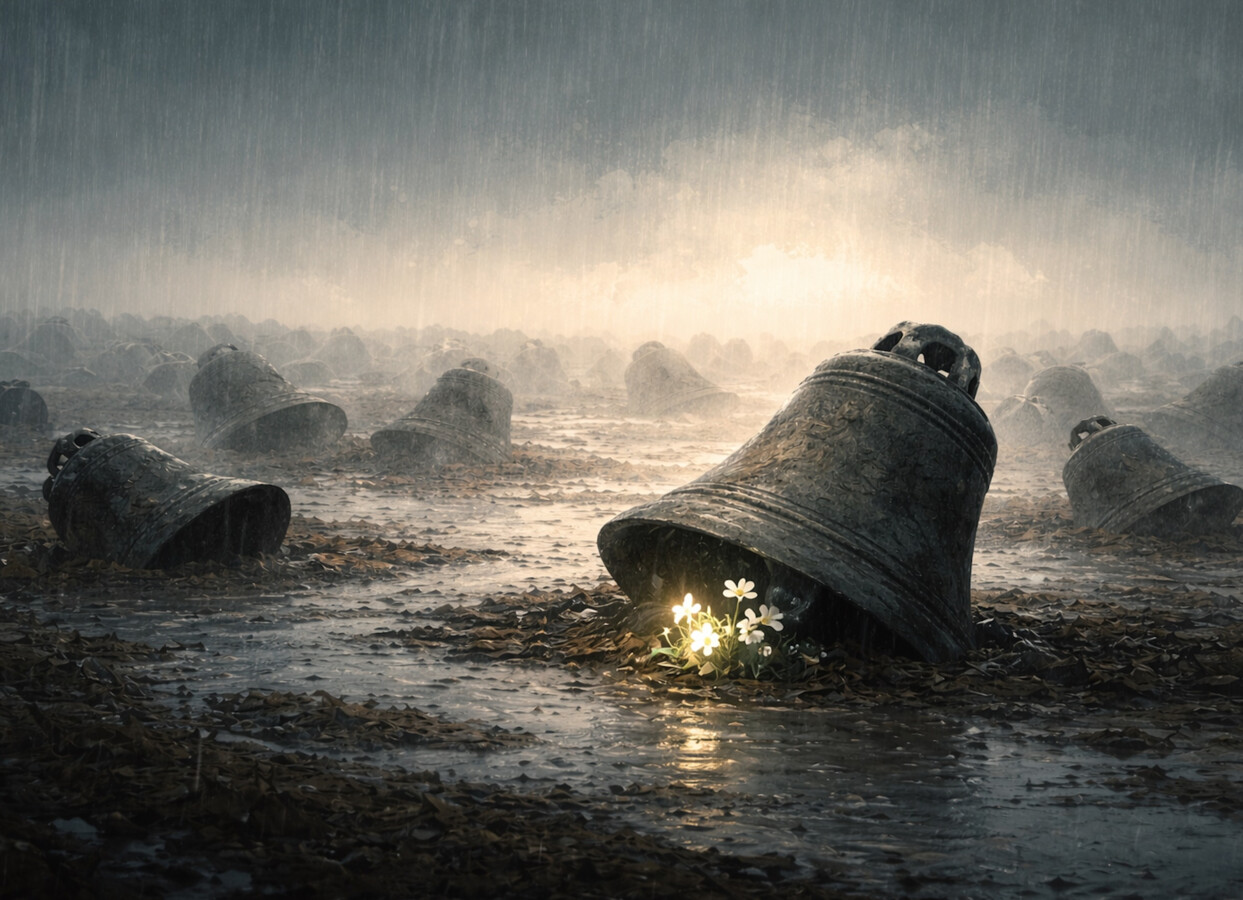
Bells—hundreds of bells—lie in the mud and remain silent. And then it begins to rain. Rain and hail.
Now a short break for The Monster’s Voice in Gdańsk. And in a moment, I’m flying off to an alien planet.