

THEME III
‘Modernity’ as a concept is so often associated with modernity that it comes as something of a shock to find the word ‘modern’ in use as far back as the fifth century AD.
Frederic Jameson, A Singular Modernity
Once at Bar-le-Duc Montaigne saw a portrait which René, King of Sicily, had painted of himself, and asked, "Why is it not, in like manner, lawful for every one to draw himself with a pen, as he did with a crayon?" Off-hand one might reply, Not only is it lawful, but nothing could be easier. Other people may evade us, but our own features are almost too familiar. Let us begin. And then, when we attempt the task, the pen falls from our fingers; it is a matter of profound, mysterious, and overwhelming difficulty.
Virginia Woolf, Montaigne
In using the myth, in manipulating a continuous parallel between contemporaneity and antiquity, Mr. Joyce is pursuing a method which others must pursue after him. They will not be imitators, any more than the scientist who uses the discoveries of an Einstein in pursuing his own, independent, further investigations. It is simply a way of controlling, of ordering, of giving a shape and a significance to the immense panorama of futility and anarchy which is contemporary history. […] Instead of narrative method, we may now use the mythical method. It is, I seriously believe, a step toward making the modern world possible for art.
T.S. Eliot, Ulisses, Order and Myth
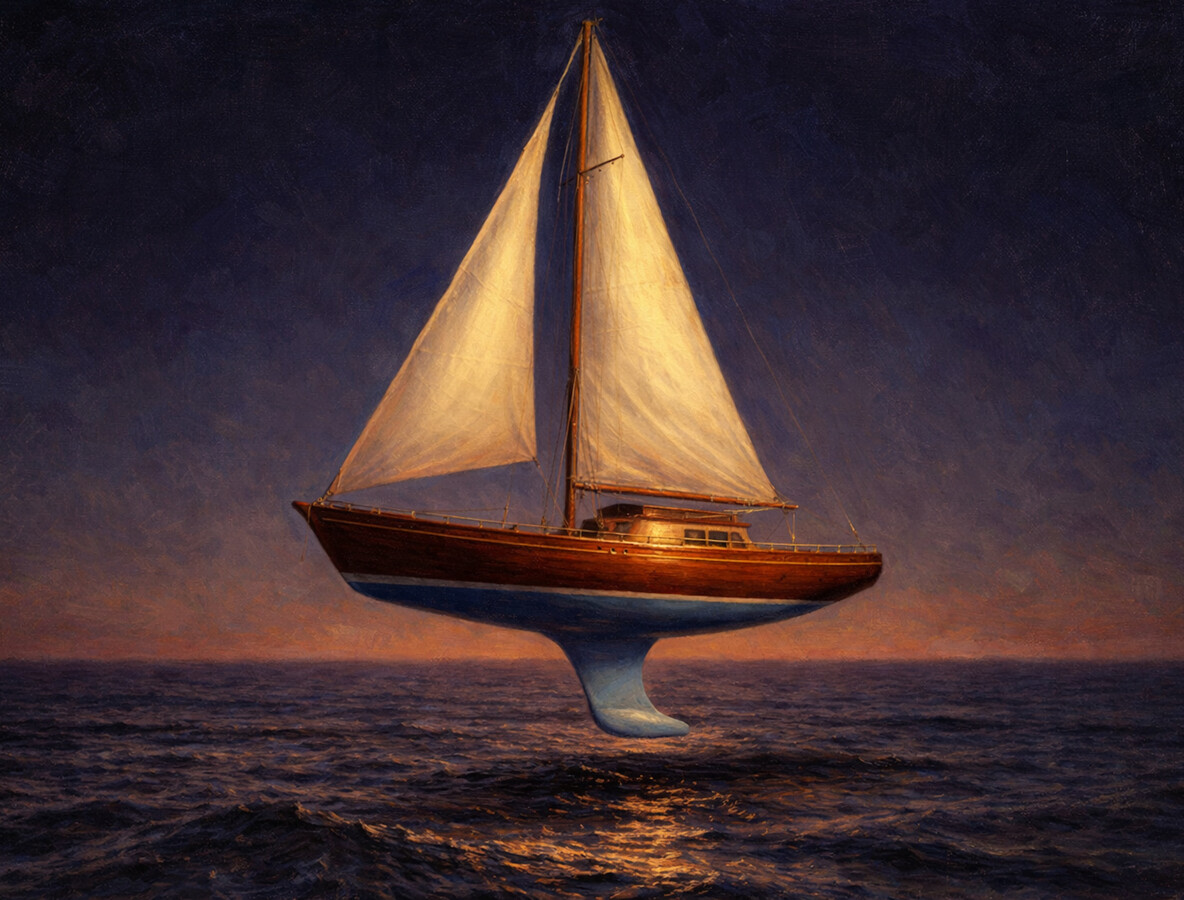
Strange is this voyage across this sea. One is a boat, with its bow set in some direction and a stern behind which something is always disappearing. One makes landfall on certain shores, enters certain harbors and departs from them, drops anchor and weighs it again. Yet there remains one home port to which, even if one never returns, one still belongs, and by whose measure everything else is measured.
My home port is modernism. More than that—I feel myself to be part of an entire fleet sailing under the flag of modernism, and to tell the truth it seems to me quite a large fleet, indeed a common one, even if not all vessels are eager to fly that flag. Some do not fly it because they dislike it, others because they do not know they have it, and still others festoon themselves with any number of different flags in the belief that they can disown their roots. No matter.
It is a very old port, despite all appearances and the somewhat misleading name. It has changed; at times it was loud and central, at times marginal, almost fading away. But it endured, and still endures, and now it is doing better than ever. I see its’ bright future.
And what does that mean?
First, it means attaching importance to the individually felt “I.” Sometimes in explicit opposition to overarching orders and narratives, at other times in accord with them, yet while preserving independence and autonomy. It means an awareness of cosmic order—or disorder—together with an irrepressible need to enter the current that runs from the cosmic horizon toward individual depth. It means respecting transcendence, yet remaining mistrustful of it and reserving for oneself the freedom to choose.
At the same time, however, secondly, it does not mean that only the subject stands at the center, that everything is subjectified. The subject is not necessarily like a mast to which one can lash oneself in order to survive a storm, but rather like a keel: not part of the boat’s visible shape in its natural environment, which everyone knows, because it always remains submerged, yet without it the boat cannot be steered.
As a consequence, sense and truth are not regarded as things to be discovered, but as manifestations of expression. They are generated—in action. They appear in situations; in forms, in reconfigurations: of memory and of the tools of communication. They are not given; they are possible, and bringing them forth is a matter of decision and sustained effort. They rest on a meaning that is sought, but not encoded in a reality independent of the subject; rather, it is staged—embodied—through the subject.
It further follows that special importance is attached to the material that yields, though with resistance, to these subjective efforts. The concrete bearer of content—of memory, of meanings, and of their transformations, whether word, shape, color, sound, or something else—moves into the foreground, emancipates itself, and in a sense itself becomes a subject. It reflects upon itself, together with its own history and the trajectory toward the future marked out by inertia.
Modernism is born of contradiction; of a spirit of resistance. But not necessarily of negation. Rather, of critical reflection and transformation. In its current manifestations it is often misunderstood as a force of defragmentation and relativization. It has accumulated prefixes such as post-, neo-, and meta-. I do not trust them; I consider most of them misguided and unnecessary. It is still the same port, though of course not all the ships departing from it are of the same size and construction. Many drift, having forgotten their keel; many have struck a reef and sunk, or else rotted on a sandbank.
Modernism, as I understand it, neither negates nor relativizes, but integrates. It recognizes contradictions and tensions between what has been and what may yet be, and allows them to coexist and bear fruit. It may be ironic, but not programmatically so. It takes very little for granted, pays homage to little, flees dogma, yet does not avoid conversation about values, including moral values—it stubbornly returns to that ground, despite successive disappointments, disenchantments, and disgraces. It does not evade responsibility. It is skeptical, but not cynical. It does not exclude the possibility of system, though toward every systemic proposal it is, by nature, deeply mistrustful.
Modernism is and always will be deeply immersed in history, and at the same time unfinished.
Some of the maps I have looked into
Astradur Eysteinsson, The Concept of Modernism
Frederic Jameson, A Singular Modernity. Essay on the Ontology of the Present
Jason Ā. Josephson- Storm, The Myth of Dissenchantment; Metamodernism. The Future of Theory
Charles Taylor, Sources of the Self. Making of the Modern Identity