

SUMMARY I
What, so far, have I actually been trying to say?
That reality is concealed.
That the form in which reality reveals itself is the world.
That this revelation takes place through the subjective act of drawing a map.
That this act unfolds in time—or perhaps even as time.
That time is complex and dynamic, and that tension–conflict lies at the heart of its nature.
Furthermore, that the elements of the emerging map coalesce into categories—themes.
That the process of mapping gives rise to the spectral figure of the cartographer: the subject–identity.
That subjectivity–identity is amorphous, and that every one of its incarnations is provisional and should not become the object of excessive attachment.
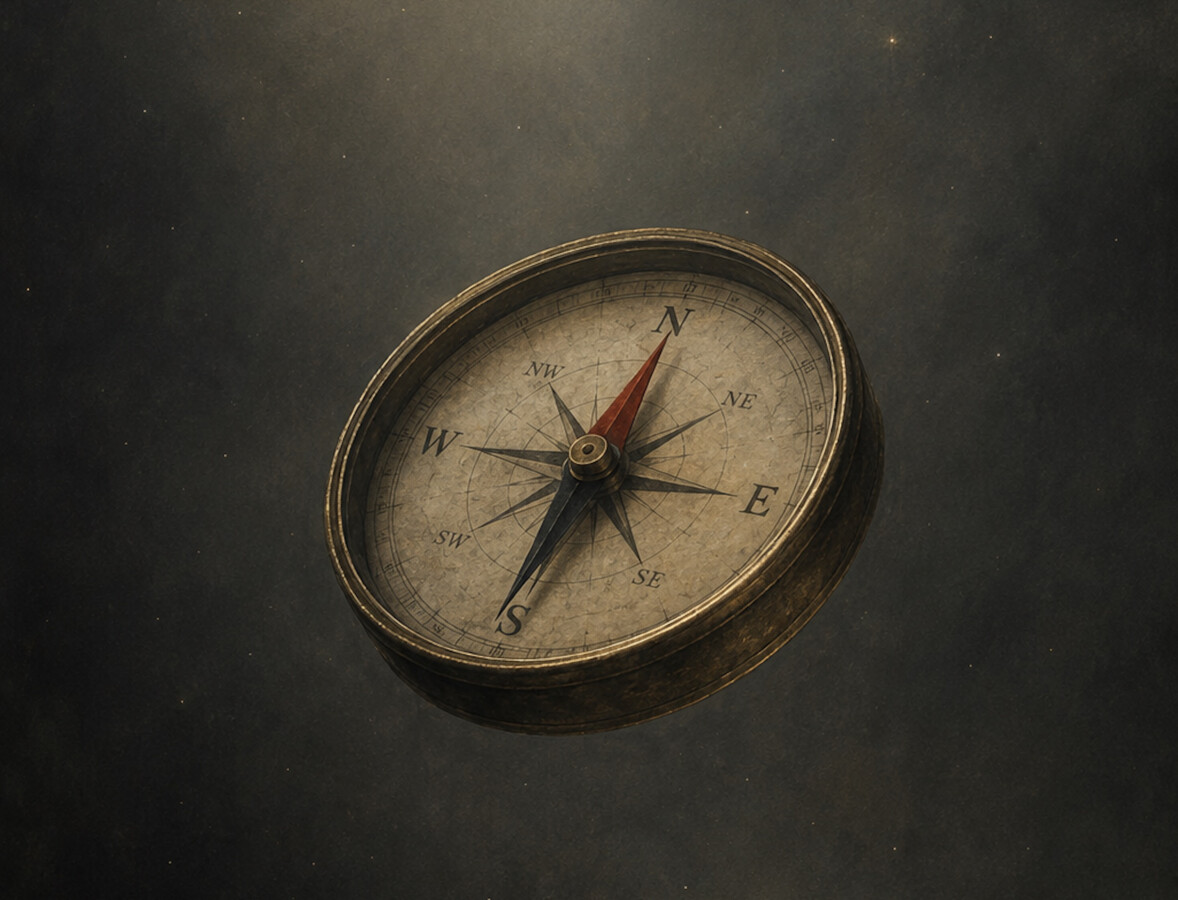
That reason is the subject’s compass, and its needle aligns itself with the field of meaning.
That language is the instrument by which meaning is generated and transformed, while understanding—and its derivative, mutual understanding—are asymptotes (limit values that can never be reached, only approached) of the function of language.
That, on the ground of language, there emerge and evolve tools—connections between different elements of the map—which, in their mature form, constitute drama: a form that provides an intersubjective image of the world (or worlds), reflecting everything above more fully than any other.
And finally, that any effort, undertaken at any moment, not so much to resolve conflict as to recognise it and sustain it constructively, is what I call modernism.
I did not mean to suggest that this is a complete or definitive picture of things, or even a true one, though I believe it contains at least fragments of truth. Nor do I imagine it to be particularly original; I know it is an eclectic collection of older and newer ideas and observations, gathered here and there and understood through plain common sense—the only one I have. However imperfect, incomplete, and unoriginal, I need it. On its basis, I want to say a few more things about music—and that, briefly, is what comes next.